
"That's Politics"
NY Times podcast "The Protocol," episode 6

This is my final post on the NY Times podcast series, “The Protocol.” For those of us who have spent the past few years studying the science and nonscience of pediatric gender medicine – which its devotees call “gender affirming care” – the script and aim of the NY Times podcast “The Protocol” could be seen from ten miles away. It goes like this: A brilliant, life-saving form of medical care was applied too widely, with too little assessment by some. In the backlash, opportunistic right-wing bigots who hate any deviation from standard gender roles exploited these mistakes and excesses by banning the care altogether. This leaves trans kids and their desperate parents the victims, stranded without crucial care.

It’s all quite slick. Even some who should have known better praised the series for its depth and even-handedness. Ha!
I have discussed the misrepresentations in episodes 1 to 5 in earlier posts. In episode 6 we get to the crux of the matter. Here, the producer, Austin Mitchell, conveys the key message to all NY Times readers and listeners who have become a little confused about “gender affirming care” and don’t know what to think. Both extremes are bad, is the message. Help those young trans kids and make sure you do proper assessments. Don’t go the way of the heartless reactionaries and ditch this essential care.
Episode 3 had already established Laura Edwards-Leeper as the “moderate” navigating carefully between undesirable extremes. Given that Edwards-Leeper has written enthusiastically about prescribing puberty blockers, cross-sex hormones and mastectomies to “gender non-conforming” minors, you will have gathered that she was miscast in this role. Episode 6 introduces us to Scott Leibowitz, who had trained with Edwards-Leeper and then moved to a children’s hospital in Columbus Ohio. He describes the “worst year in his career,” when pediatric gender medicine was banned in Ohio – a piece of legislation he had initially thought was “such an overreach” that it had “no chance of passing.”
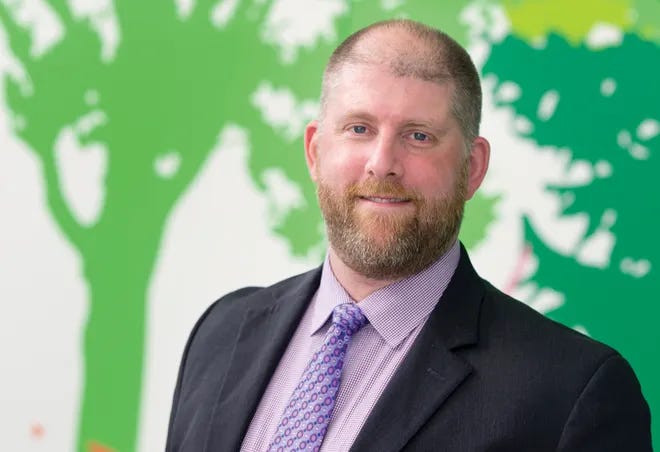
Scott Leibowitz
Then Azeen Ghorayshi interviews Leibowitz. He refers to patients whose stress levels have gone sky-high and laments the climate of “hopelessness” the ban has created. He says Edwards-Leeper’s predictions back in 2018 have come true: she had feared that with more clinics departing from the “assessment-based model,” more young people would come to regret their decisions. Those experiences would be “weaponized by opponents of the care,” causing a backlash.
Yes, it all came true, Mitchell tells us: “a small but outspoken group of mainly young women, who had transitioned as adolescents and later regretted it became recurring figures on rightwing media and in public testimonies in support of the bans.”
Just imagine we were talking about the ill effects of OxyContin – or heroin for that matter. Or alcohol or nicotine. Just imagine we were talking about young people who are willing to testify to help prevent other teenagers from making the same mistakes they made. It is so difficult for detransitioners to come forward. They often have multiple mental and physical health issues and feel ashamed of their past folly. Those who nonetheless step into the glare of publicity and admit to having once adamantly insisted on decisions they now regret — many explaining they are actually lesbian but hadn’t realized it or wanted to accept it — are the bravest of the brave. Here Mitchell presents them as naive tools of the “right-wing media.” It is despicable.

While conceding that the much-quoted but debunked tiny percentage (1-2%) of people who detransition is decades old, Mitchell nonetheless quotes it before saying that more recent data suggests detransition rates may be up to 5-10%. He has not read, or ignores, those suggesting it may be up to 30% or higher. Of course not: his spiel is that detransition is rare and is being amplified unjustifiably by “opponents of the care.”
Repeating that better assessment is key, Mitchell tells us that “many providers and advocates say that the potential harm of young people receiving care is still vastly outweighed by the harm of them not receiving care.”
There is not an iota of evidence for that statement. First, “better assessment” is meaningless. Even if you accept the premise that some children will benefit from these medical interventions, not a single doctor can predict who will be happy about it in ten years’ time and who won’t. Second, the “providers and advocates” consist of those with a financial, intellectual, or ideological stake in this industry and parents who have medicalized their own children – parents who will always defend their actions, because the alternative is too terrible to contemplate.
Ghorayshi asks Leibowitz about suicide and suicidality. He skitters away from this “complex issue” – as well he might. But Mitchell has no trouble leaning into it. He makes a confusing statement: He rightly notes the data doesn’t clearly show that puberty blockers or hormones cause the risk to decrease in kids. But in the same breath he adds: “What the data does show is that having supportive families does protect these kids.” Of course: but what are “supportive families”? Those who go along with the demands for blockers and hormones, or those who spend years of loving guidance with their child, helping them to solve their problems in other ways?
As for suicide: in the United Kingdom, the government advisor on suicide prevention, Sir Louis Appleby, has had to make repeated public statements, urging trans activists to stop talking about suicide. Just a few days ago he responded to false claims on X:
“So we’re back to claims about suicide in young trans people. A few indisputables:
Young ppl with gender dysphoria may be at risk – co-existing mental disorder, autism, bullying, etc.
No reliable evidence that puberty blockers reduce risk
“dead child” rhetoric is dangerous.”
But Leibowitz is a true believer in the life-saving properties of “gender affirming care.” He demands to know, in a tone of anguish: “What is wrong with saying that banning this care is wrong because it negatively affects people’s quality of life? – which is fully true.” This is a profession of faith – nothing more. No one who has not followed a large cohort of patients for at least 10 years has a right to make such a statement. It’s all about short-termism — the bright sparkle in the eyes that Marci Bowers talked about in episode 5. And then, of course, we’re back to politics. Leibowitz says there is “a laser-focused mission, that has a very well oiled financial machine behind it, in politics on the right, that is destined [does he mean “determined”?] to eliminate trans care -- and basically trans rights and trans people.”
This ridiculous notion – that urging better care for distressed young people is akin to wanting to wipe out part of the population – is one of the most distasteful lies that are repeated about this issue. And then the “financial machine” -- it’s always amusing when genderati start talking about the hostile financial forces on the right. As anyone who has spent five minutes on this issue knows, pediatric gender medicine is a billion-dollar growth industry. It is being curbed a little by the bans, but private medicine is still going strong. As for “the right” – the notion that opposition to children being given harmful drugs and surgery instead of appropriate care because they don’t conform to outdated sexist stereotypes is somehow right wing is just baloney. We all know why most Democrats who feel the same way keep quiet about it — in spite of urgent pleas by Kara Dansky, DIAG, the LGB Courage Coalition, and others — it’s because the radical young activists who do most of the work on the ground and above all the party’s major donors have a stranglehold over the Democratic Party. Everything in the US seems to come down to money.
Leibowitz makes some muddled comments about sex and gender. He says that what his opponents want is “to create a society that they feel is ideal – a society that has people with two sexes, and that their gender is automatically what their sex is, and that the role of that gender is pre-defined.”
This is so weird. It’s part fact (there are indeed two sexes), part 1950s prejudice, part fantasy. Like many of those around me, I have defied all sex-based roles and expectations all my life. I do not have a “gender” (by which I assume he means “gender identity”). Does he not know any people like me? Does he think everyone who is not GI Joe or Barbie is trans? It’s baffling.
His final comment is that we all have to agree that “trans identity is valid” before we can get anywhere. Without defining what that means. Oh dear. His thought processes seem a bit of a mess. Maybe that is what working in a gender clinic does to you.
Mitchell then brings up the terrible specter of Trump: First the Executive Order on two sexes [which Trump calls “genders” because he doesn’t understand the point] with a scary drumbeat in the background. Followed by the Executive Order withdrawing federal funds from pediatric gender medicine.
In the buildup to his conclusion, Mitchell says that while the politics have intensified, there are still kids who are asking for help and parents who are deciding what to do. The message couldn’t be clearer: the “care” is “life-saving.” Some people did it wrong, which was eagerly “weaponized” by well-funded right-wing bigots. Meanwhile, the poor kids and their parents are stuck in the middle.
The plaintive voices we hear in the last 22 minutes of the episode are pure emotional manipulation. The aim is to tell NY Times readers and listeners what they are supposed to think about “gender affirming care,” especially in the wake of the Skrmetti ruling. A couple of dissenters are included, but most of those we hear from are true believers: kids who say they have always known they were “trans,” others who say “transition” saved their lives, and heartbroken parents planning to move out of state or to leave the US altogether.
I am left imagining a drug addict deprived of his fix – and media telling him another fix will save him. I am also reminded of the ridiculous fantasies spread by the psychologist Diane Ehrensaft, who is notorious for telling audiences that babies know if they are “transgender”:
Winding down, Mitchell quotes recent statistics showing that most Americans – including a majority of Democrats – support bans on pediatric gender medicine, adding that we are in a very different climate from decades ago. That is true. The final words of the podcast, musing on the change in public opinion, are from Annelou de Vries: “That’s politics.”
No, it isn’t, Annelou. No it isn’t, Austin. No it isn’t, NY Times. The change is not “politics” but knowledge and understanding. And a fair bit of rage. The American public now knows that the youth medical “transition” industry is the worst part of a dangerous cult. And in ever greater numbers, whatever their political affiliation, they are rejecting it.
At some point, the New York Times will have to stop spreading this propaganda.
Great analysis, Bev. I don't disagree with any of it, but I do have a name correction: the lunatic UCSF gender nut is Diane (not Barbara) Ehrensaft. Barbara Ehrenreich was a great non-fiction writer whose name is unfortunately too close to that of an absolute villain, so I feel a duty to correct the record whenever I see the two conflated, even though Ehrenreich died in 2022.